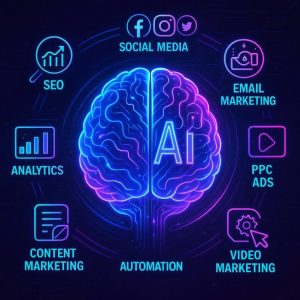
 Artificial Intelligence (AI) is transforming the way businesses connect with their customers. From personalized recommendations and automated emails to smart chatbots and predictive analytics, AI has become a powerful tool for modern marketers. Companies of all sizes are using AI in digital marketing to improve customer experiences, save time, and make better business decisions.
AI helps businesses work more efficiently by automating repetitive tasks, improving decision-making, and creating more personalized customer experiences. Today, companies of all sizes can use AI-powered tools to save time, reduce costs, generate quality leads, and strengthen their online presence.
In this guide, you’ll learn how AI works, why it has become an essential part of digital marketing, and how businesses can use it to stay ahead of the competition.
What Is AI in Digital Marketing?
AI in digital marketing refers to the use of artificial intelligence technologies to automate, analyze, and improve digital marketing activities. AI systems collect and process large amounts of data, identify patterns, and make intelligent decisions faster than humans.
Instead of relying only on manual work, marketers can use AI to:
- Analyze customer behavior
- Create personalized content
- Improve SEO strategies
- Automate email campaigns
- Optimize paid advertisements
- Predict future trends
- Enhance customer support
AI helps businesses make smarter marketing decisions based on real data rather than guesswork.
How Does AI Work?
Artificial Intelligence works by combining several advanced technologies that enable computers to learn from data and improve over time.
1. Data Collection
AI gathers information from websites, social media platforms, customer interactions, search engines, online purchases, and marketing campaigns.
The more quality data available, the more accurate AI becomes.
2. Machine Learning
Machine Learning is one of the most important parts of AI.
Instead of following fixed instructions, machine learning algorithms study patterns within data and continuously improve their predictions as more information becomes available.
For example, Netflix recommends movies based on your viewing history, while Amazon suggests products you may want to buy.
3. Natural Language Processing (NLP)
Natural Language Processing allows AI to understand and generate human language.
This technology powers:
- ChatGPT
- AI chatbots
- Voice assistants
- Customer support automation
- Content generation tools
It enables businesses to communicate with customers naturally and efficiently.
4. Predictive Analytics
AI examines historical data to forecast future customer behavior.
Businesses use predictive analytics to determine:
- Which customers are likely to buy
- Best times to send emails
- Products customers may purchase
- Campaigns likely to perform best
These predictions improve marketing effectiveness and reduce wasted spending.
Benefits of AI in Digital Marketing
Saves Time
AI automates repetitive tasks such as scheduling social media posts, sending emails, generating reports, and responding to customer inquiries.
Improves Customer Experience
AI personalizes website content, product recommendations, and marketing messages based on user preferences.
Better Decision-Making
Instead of relying on assumptions, businesses use AI insights to make informed marketing decisions backed by data.
Higher Conversion Rates
AI helps marketers target the right audience with personalized campaigns, increasing the chances of conversions and sales.
Cost Efficiency
Automation reduces manual effort, allowing businesses to achieve better results with fewer resources.
Applications of AI in Digital Marketing
AI for SEO
SEO has become more data-driven with AI.
AI tools help marketers:
- Find relevant keywords
- Analyze competitors
- Optimize content
- Suggest internal links
- Improve search rankings
- Identify technical SEO issues
These insights make it easier to create content that aligns with search intent.
AI for Content Creation
Creating quality content consistently can be challenging.
AI writing tools assist marketers by generating:
- Blog outlines
- Social media captions
- Product descriptions
- Email campaigns
- Video scripts
- Ad copy
While AI speeds up content creation, human editing remains essential to ensure originality, accuracy, and brand voice.
AI for Social Media Marketing
AI helps businesses manage multiple social media platforms more effectively.
It can:
- Schedule posts
- Recommend posting times
- Analyze audience engagement
- Suggest trending hashtags
- Track campaign performance
This allows marketers to focus on strategy rather than repetitive tasks.
AI for Email Marketing
Email marketing becomes more effective with AI.
AI can:
- Personalize subject lines
- Segment audiences
- Recommend products
- Predict open rates
- Optimize sending times
Personalized emails often achieve higher engagement than generic campaigns.
AI for Paid Advertising
Platforms like Google Ads and Meta Ads use AI to optimize advertising campaigns.
AI helps by:
- Adjusting bids automatically
- Finding the right audience
- Improving ad placements
- Reducing advertising costs
- Increasing return on investment (ROI)
AI Chatbots
AI-powered chatbots provide instant customer support around the clock.
They can:
- Answer common questions
- Collect leads
- Book appointments
- Recommend products
- Resolve simple customer issues
This improves customer satisfaction while reducing support costs.
Popular AI Marketing Tools
Businesses today have access to many AI-powered marketing platforms.
Some popular tools include:
- ChatGPT
- Google Gemini
- Jasper AI
- Surfer SEO
- Grammarly
- Canva AI
- HubSpot AI
- Semrush AI features
- Copy.ai
- Notion AI
Each tool helps improve different aspects of digital marketing, from content creation to analytics and automation.
Challenges of Using AI
Although AI offers many advantages, businesses should also understand its limitations.
Some common challenges include:
- Dependence on high-quality data
- Lack of human creativity
- Privacy and data security concerns
- Potential bias in AI models
- Need for human review of AI-generated content
The best results come from combining AI with human expertise rather than replacing people entirely.
The Future of AI in Digital Marketing
The role of AI will continue to grow in the coming years.
Businesses can expect:
- Smarter search experiences
- More personalized customer journeys
- Better voice search optimization
- AI-generated video content
- Advanced predictive marketing
- Improved automation
- Faster customer service
- More accurate campaign analysis
Companies that embrace AI responsibly will be better positioned to adapt to changing consumer expectations and digital trends.
Conclusion
Artificial Intelligence is reshaping the future of marketing by helping businesses work smarter, deliver personalized experiences, and make better decisions. Whether it’s improving SEO, creating content, automating email campaigns, or optimizing advertising, AI in digital marketing has become an essential part of modern business growth.
However, AI should be viewed as a powerful assistant—not a replacement for human creativity and strategic thinking. The most successful marketing strategies combine intelligent automation with genuine human insight.
As digital marketing continues to evolve, businesses that learn how to use AI effectively will be better equipped to attract customers, build stronger relationships, and achieve long-term success.
Frequently Asked Questions (FAQs)
1. What is AI in digital marketing?
AI in digital marketing is the use of artificial intelligence technologies to automate, analyze, and improve online marketing activities.
2. How does AI help businesses?
AI helps businesses automate repetitive tasks, personalize customer experiences, improve marketing performance, and make data-driven decisions.
3. Can AI improve SEO?
Yes. AI assists with keyword research, content optimization, technical SEO analysis, competitor research, and search intent analysis.
4. Which industries benefit from AI marketing?
Almost every industry—including retail, healthcare, education, finance, travel, real estate, and e-commerce—can benefit from AI-powered marketing.
5. What are the best AI marketing tools?
Popular tools include ChatGPT, Google Gemini, Jasper AI, Surfer SEO, Canva AI, HubSpot AI, Grammarly, and Copy.ai.
6. Is AI suitable for small businesses?
Yes. Many affordable AI tools help small businesses automate marketing tasks, create content, and improve customer engagement.