
What Is a Search Engine?

A search engine is a powerful online tool that helps users find information, websites, products, images, videos, news, and other content available on the internet. Instead of manually visiting different websites, users can simply type a keyword, question, or phrase into a search engine and receive a list of relevant results within seconds.
Search engines work by using automated programs called crawlers or spiders to discover and scan web pages. The information collected from these pages is then organized and stored in a large database called an index. When a user performs a search, the search engine analyzes the query and uses various ranking factors and algorithms to determine which pages are most relevant and useful.
HOW DOES SEO WORKS ?
A search engine generally works in three main steps:
Crawling – Search engines use bots (also called crawlers or spiders) to discover and scan web pages.
Indexing – The information collected from these pages is organized and stored in a huge database called an index.
Ranking – When someone searches for something, the search engine analyzes its index and displays the most relevant pages first.
WHAT IS SEARCH ENGINE OPTIMIZATION ?
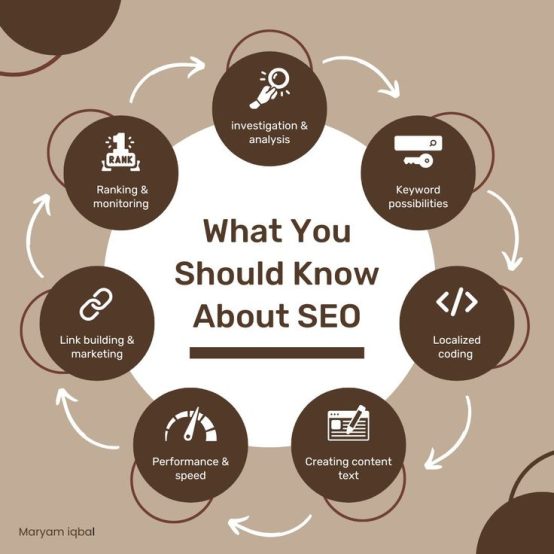
SEO (Search Engine Optimization) is the process of improving a website to increase its visibility and ranking on search engines like Google and Bing. It focuses on optimizing website content, keywords, technical elements, and user experience so that search engines can better understand and recommend the website.
The main goal of SEO is to attract organic (unpaid) traffic, reach the right audience, improve online visibility, and generate more potential customers. Unlike paid advertising, SEO helps a website gain visibility naturally and can provide long-term results when implemented consistently.
TYPES OF SEO
SEO is mainly divided into three major types, each focusing on a different part of improving a website’s search engine visibility.
1. On-Page SEO
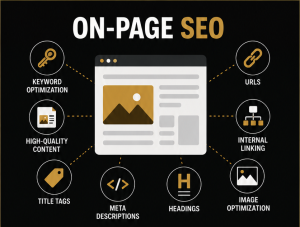 On-Page SEO refers to optimizing the elements and content within your website to make each page more relevant, informative, and easy for both users and search engines to understand. It plays an important role in helping search engines determine what your website is about and which search queries it should appear for. It includes keyword optimization, high-quality content, title tags, meta descriptions, headings, URLs, internal linking, and image optimization.
Goal of On-Page SEO
The main goal is to make your website content relevant, useful, well-structured, and easy for search engines to understand, helping your pages achieve better visibility in search results.
2. Off-Page SEO
 Off-Page SEO involves activities outside your website that help improve its credibility, authority, and reputation. The main focus is on earning high-quality backlinks from trusted websites, along with brand mentions, digital PR, and other external signals that can strengthen your website’s authority.It includes backlink building, guest posting, brand mentions, digital PR, social media promotion, online reviews, and influencer outreach.
Goal of On-Page SEO
The main goal is to build website authority, credibility, and trust through external signals.
3. Technical SEO
 Technical SEO focuses on improving the technical foundation of your website so that search engines can easily crawl, understand, and index your pages. It includes improving website speed, mobile-friendliness, site structure, XML sitemaps, HTTPS, crawlability, and fixing technical errors that may affect search performance.It improves the technical performance of your website, including page speed, mobile-friendliness, crawlability, indexing, and site structure.
Goal of On-Page SEO
The main goal is to make your website easy to crawl, index, and perform efficiently in search results.
Classification Of SEO
White Hat SEO – Uses ethical, search-engine-approved techniques to improve rankings naturally
Black Hat SEO – Uses manipulative or prohibited techniques to achieve faster rankings, which can lead to penalties.
Grey Hat SEO – Uses techniques that are not clearly prohibited but may still carry SEO risks.